Basics · 5 min read
How Much Extra Tile to Buy: Wastage Percentages Explained
How much wastage to add when buying tiles: typical percentages for straight, diagonal and large format layouts, with worked examples and spare tips.
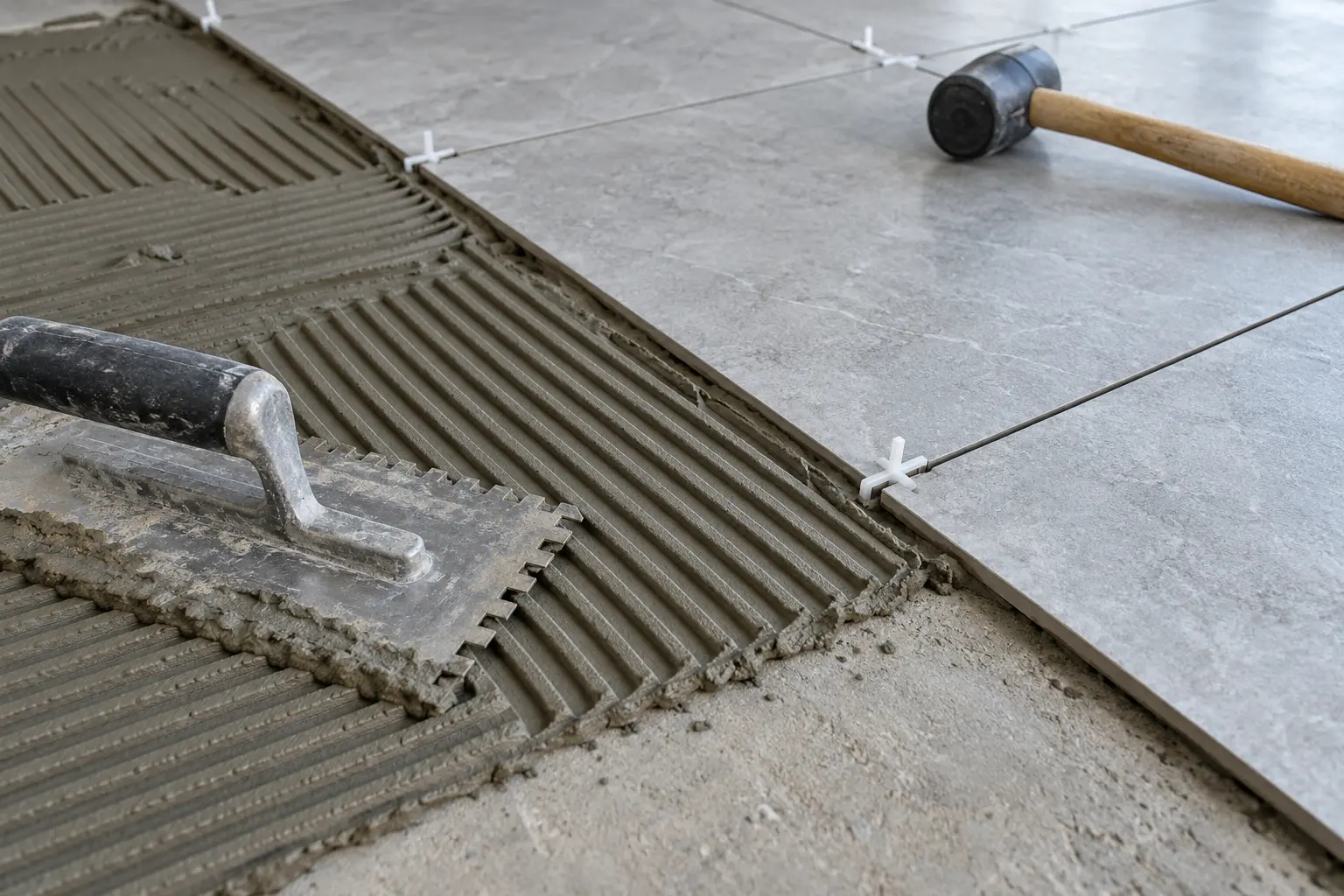
No tiling job uses exactly the number of tiles the area suggests. Tiles get cut at walls and corners, a few break in handling, and some get rejected for chips or shade. The extra you buy for this is called wastage. Too little and you run short mid-job. Too much and you have boxes gathering dust. Here is how to get it about right.
Why you need extra tiles
- Cuts at the edges: every row ends at a wall, and that last tile is usually cut. The offcut is often too small to use elsewhere.
- Corners, pillars and door frames: each one needs shaped cuts.
- Breakage: tiles can crack in transport, while cutting or if dropped.
- Rejects: a chipped corner or a slightly off-shade tile should not go on your floor.
- Future repairs: a few spares from the same batch are very useful later.
Typical wastage by layout
| Layout or situation | Typical extra to add |
|---|---|
| Straight lay, simple rectangular room | 5 to 8% |
| Straight lay, room with some corners or a pillar | 8 to 10% |
| Brick or offset pattern | 10% |
| Diagonal lay | 12 to 15% |
| Herringbone or chevron | 15% or more |
| Large format (800x1600 mm and up) in small rooms | 10 to 15% |
| Staircases and small, cut-heavy areas | 15% or more |
These are typical ranges, not fixed rules. An experienced mason who plans cuts carefully will waste less. A room with many angles will waste more.
Worked example: same room, different layouts
Take a 12 x 14 ft room (168 sq ft) with 600x600 mm tiles. Each tile covers 3.875 sq ft, so the room needs 168 / 3.875 = 43.35 tiles before wastage. (See our step-by-step guide on how to calculate tiles.)
| Wastage | Calculation | Tiles to buy |
|---|---|---|
| 5% | 43.35 x 1.05 = 45.5 | 46 |
| 10% | 43.35 x 1.10 = 47.7 | 48 |
| 15% | 43.35 x 1.15 = 49.9 | 50 |
So in this room, the difference between a straight layout and a diagonal one is about 4 tiles. If the tiles come 4 to a box, that is one extra box. The tile calculator lets you try different wastage percentages quickly.
Rounding up to full boxes
Tiles are sold in boxes, and box quantities vary by size and manufacturer. Always round up to the next full box after adding wastage.
Example: a 10 x 12 ft room (120 sq ft) with 600x1200 mm tiles.
- One tile covers 7.75 sq ft.
- 120 / 7.75 = 15.48 tiles.
- Add 10%: 15.48 x 1.10 = 17.03, so 18 tiles.
- If the box holds 2 tiles, 18 / 2 = 9 boxes.
Notice that 17.03 rounds up to 18, not down to 17. Always round up at each step.
Large tiles and small rooms
Large formats look great, but in a small room they can produce more waste. Imagine a 7 ft wide passage with 1200 mm (about 3.94 ft) long tiles. One full tile plus a cut piece of about 3.06 ft covers each row, and depending on the layout, that offcut may or may not be usable on the other side. If it is not, you are wasting a large part of a tile on every row.
Before buying large tiles for a small space, ask your mason to sketch the layout. Our guide on large format tiles pros and cons covers this.
Do not forget these extras
- Skirting: often cut from floor tiles. Add the running length of skirting to your plan.
- Door thresholds and steps between rooms.
- Balcony and utility area, which people sometimes forget to add.
- Loft and store rooms, if you are tiling them.
Keep spares from the same batch
Tiles are made in batches, and each batch can have a slightly different shade. If you buy more later, even the same design may not match exactly, and designs are also discontinued over time. So:
- Buy the full quantity at once, from one batch. See tile batch, shade and grade.
- Keep at least 3 to 5 spare tiles for each design, or one unopened box for larger areas.
- Label the spare box with the room name and store it somewhere dry.
When to buy less
You can stay at the lower end of the range if:
- The room is a simple rectangle with no pillars.
- You use a straight layout.
- Your mason is experienced and plans cuts carefully.
- The tile is small (300x300 mm), so offcuts are small too.
Check your numbers with us
Bring your room sizes and layout idea to Patidar Ceramic, or call us. We will help you work out a sensible quantity with the right wastage for your layout, using the tiles currently in stock.
Common questions
How much extra tile should I buy?
Usually 5 to 10% extra for a straight layout in a simple rectangular room. For diagonal, herringbone or rooms with many corners and pillars, 12 to 15% is safer.
Why do large tiles need more wastage?
In small rooms, each cut on a large tile leaves a bigger offcut that often cannot be reused. Large tiles are also costlier to break, so a little extra margin helps.
Should I keep spare tiles after the job?
Yes. Keep at least a few tiles, or one box, from the same batch. If a tile cracks later or plumbing work needs a repair, the same design and shade may no longer be available.
Can I return extra tile boxes?
Policies differ from shop to shop, so ask before you buy. It is better to agree on this upfront than to assume.
Keep reading
How to Calculate Tiles for a Room: Simple Steps with Examples
Work out how many tiles and boxes you need for any floor or wall, with a worked 12 x 14 ft example, a tile size table and sensible wastage figures.
Tile Batch, Shade and Grade Explained: Avoid Mismatched Floors
Why tiles from different batches can look different, what shade and grade codes on the box mean, and how to make sure your whole floor matches.
Large Format Tiles: Pros, Cons and When They Make Sense
Big tiles like 800x1600 mm and 1200x2400 mm look clean and modern, but need a flat base and skilled laying. Here is what to weigh before you buy.
See the tiles in person before you decide
Photos never show a tile's true shade or texture. Get in touch to check what is in stock, then walk in and compare.